B72, also called the Snake Nebula, in Ophiuchus is another of Barnard’s discoveries. When observing dark nebulae such as this, you’re looking for dark places in the heavens. Such a search requires good skies where the richness of the Milky Way makes it obvious when something is obscuring it. (Earthly clouds don’t count!)
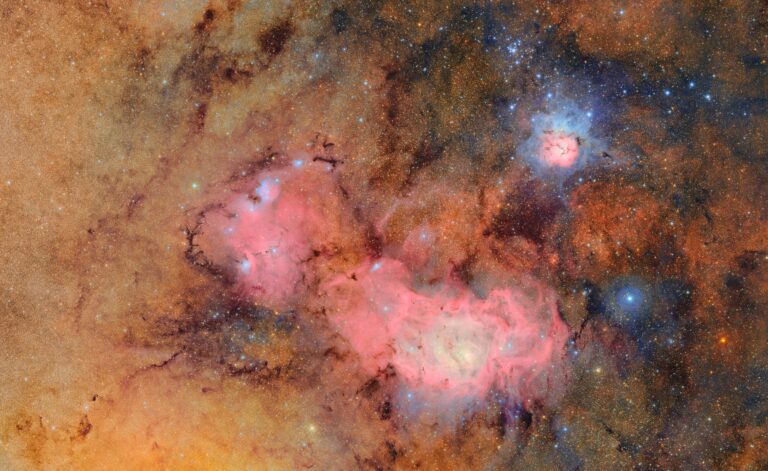
Considered relatively nearby at 650 light-years distant, B72 is compact, running 6′ in a northwest–southeast direction. It is narrow, ranging from 2′ to 3′ thick. The densest part of the dust cloud forms an S; it was called the S Nebula before the moniker Snake Nebula became popular. Its 5-light-year-long sinuous nature appears in small telescopes under skies where the Milky Way glows bright. Look about a degree and a half north-northeast of Theta (θ) Ophiuchi, a magnitude 3.25 multiple star. The area is rich in dark clouds. Look for a set of nearby “holes” (“plugs” might be more apropos) in the background glow: B68, B69, B70, and B74. (Barnard 68 is the densest and darkest of the four.)
The whole region is a wonder to scan with a wide-field telescope or large binoculars. The Snake is at the top of the Pipe Nebula, a large cloud spanning 5° in length and more than 3° in width. That’s large enough to be visible to the naked eye from latitudes with good views of the southern sky. And if the Snake and Pipe aren’t enough, they’re also part of a large nebular complex called the Dark Horse Nebula, which covers a generous 10° by 10°.