Lanza, a scientist at the Los Alamos National Laboratory who works on the Mars Curiosity rover team, was in Antarctica with this group as part of NASA’s Antarctic Search for Meteorites Project. Antarctica is like the solar system’s asteroid landfill. Pieces of the Moon, Mars, the asteroid Vesta, and fragments of the solar system’s formation are buried under the ice. For five weeks, Lanza would hunt for meteorites, sleeping in close-quarter tents around a group of like-minded explorers.
It was, in essence, a bit like a trip to Mars. The Antarctic terrain in that region is lifeless and bitterly cold. And sure, there’s snow and ice as far as the eye can see, but for all intents, it’s also a desert. At night, Lanza says, the wind would howl and the ice would crack and she would swear there was a plane coming in. But it was like an auditory pareidolia, the propensity in humans to find familiar patterns (like faces in clouds) in random input.
She’d wake up in the middle of the night, panicked that she’d broken the strict schedule of the expedition, only to find out it was still 2 a.m. This is just what happens when the sky tricks you with a constant twilight glow.
Sensory Starvation
One day, one of her tentmates had an odd little self-care package from home. The moment opened Lanza up to something she hadn’t known was missing. “I didn’t notice it until my tentmate Morgan, a veteran of this project, had a bunch of essential oils with her and I was like ‘what is this hippie nonsense’,” Lanza says.
And that’s when it hit her. In Antarctica, the cold lifelessness robs people of sensory inputs we all take for granted — especially the sense of smell. Morgan, the tentmate, would play rain sounds and sniff on floral smells.
“It was so powerful and familiar, and I realized I had not smelled that or heard the sound of rain and was starved of that for two months,” Lanza says.
From that moment on, she’s had her mind on one thing future Mars explorers might be missing out on: the smells of everyday life, whether that’s a May lilac bloom or the strong, complex sting of compost. Like fresh veggies or talking to family in real-time, our sense of smell is a forgotten link to home.
Outer Space Lip Balm
Tanya Harrison, director of research at Arizona State University’s Space Technology and Science (NewSpace) Initiative, has been putting her lab to work on smells. It’s a two way street, both distilling the smells of Earth for future explorers as well as trying to capture the smells of space.
“ASU’s ‘smell lab’ was created in our School of Life Science to help understand things like how odors affect memory, and how our sense of smell changes due to age or disease (Alzheimer’s in particular),” Harrison says. “The lab uses honey bees and fruit flies to help us understand the sense of smell, as they are highly affected by scent.”
Harrison’s lab at ASU has also teamed up with Brian Smith of the School of Life Science to develop the Five Senses in Space project. Just as old songs take us back to early memories, an old smell can bring back a rush of memories.
RELATED: Exotic Objects in the Sky
The first smell lab project looked at the gas cloud Sagittarius B2 near the center of the Milky Way. The Spanish Institut de Radioastronomie Millimétrique telescope had detected the presence of ethyl formate. Were you to somehow grab and bottle parts of this gas cloud and bring it on board some far-future spaceship, you’d probably notice something familiar: the smell of rum. If you’re more of a mouthbreather, you might even taste a hint of raspberry.
So they recreated these clouds in the form of a lip balm as a sort of outreach project, calling it Centre of the Galaxy.
The Scent of Apollo
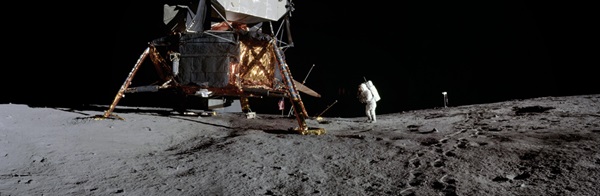
But since then, the nascent lab has taken meteorites like those Lanza and crew were hunting for. They want to draw out the possible smells of the Moon or Mars, in the former case to jog the memories of the few remaining people who’ve ever stepped foot on another world.
“Ideally we’d like to create the scent of the Moon and then get one of the remaining moonwalkers to smell it and let us know how close it smells to actually being there — well, at least the scents they described when getting back into the modules, which might’ve come from lunar dust,” Harrison says.
Creating a smell involves a process called solid phase microextraction. You put the smelly thing in a jar, and attach a filament to capture the smell emitted. Then you throw that into a couple machines to analyze the scent and figure out what molecules are giving off a particular smell. This, in turn, gives an idea of how to recreate a smell.
A simple “scratch and sniff” type of scent strip might last a couple days, but putting it into an oil — like, say, a lip balm — can make the volatile chemicals that create smell last significantly longer.
The smell lab could eventually turn to packing up a few chemicals in an oily form for the early stages of a Mars mission, but putting a smell lab on board could turn out even better.
“To maximize shelf life for astronauts, I’d imagine creating scented oils would provide the longest life,” Harrison says. “But as long as you’ve got the recipe for the scent … and the components needed to artificially create that scent, you could ideally create more as you go.”
It may be part of a suite of sensory experiences from home provided for future astronauts. NASA is already working with Microsoft on its HoloLens platform to create augmented reality experiences for astronauts. That might include audio messages from home. And maybe an astronaut longing for a hot summer day might crack open up a vial and remember the smell of fresh cut grass.
“I really think that my tentmate was onto something — I would bring essential oils with a variety of smells and a bunch of different sounds from Earth,” Lanza says as advice to future Mars explorers.
After all, in those close quarters, it could be just the thing to bring you home on an especially homesick day.
This article originally appeared on Discovermagazine.com.
Editor’s Note: The Five Senses In Space project is run through Arizona State University. An earlier version misstated its affiliation.